NZ’s oldest Internet router
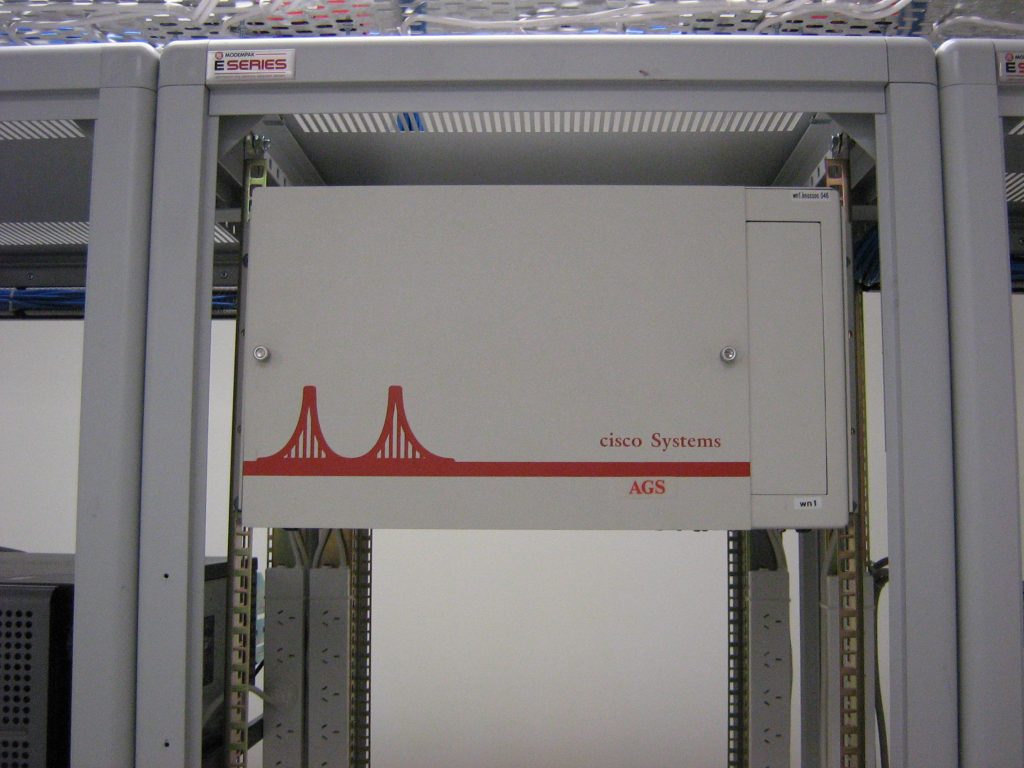
This Cisco AGS was first commissioned in the Victoria University network in January 1989. It was one of 5 Cisco MGS routers bought by VUW; as Cisco could not provide sufficient MGS chassis, three routers were provided as AGS chassis instead. The makers plate on the back has “MGS/2-4E” on the back (actually MGS/2-2E, with the 2E scratched out and replaced with 4E in pen.)
Originally, as the label implies, this unit had a CSC/2 processor card with a 68020 processor and 1MB of memory, and two 2E dual Ethernet line cards.
The router was installed as the CSC router in the Old Kirk machine room, where it served the machine room and surrounds, and with the addition of (synchronous) serial interfaces connected the Kawaihiko network links to the University of Waikato (48 kbps), Massey University (48 kbps) and a backup link to the University of Canterbury (9600 bps). At this stage, the total Internet bandwidth out of the country (landing at Waikato University) was 14.4 kbps, upgraded to 64 kbps in 1991.
The router was moved to the new CSC machine room in the Cotton Building in late 1991.
In February 1993, the CSC router was “upgraded”. The upgrade, to an AGS+/4, involved a box swap, basically a new chassis CPU and non-volatile memory card. The old AGS chassis sat unloved on the machine room floor, in the expectation that it would need to be returned. By October, however, the VUW Internetworking Group was starting to increase the number of synchronous leased line Internet connections it was handling, and also felt a need to physically split the commercial IP routing from the main campus network. It was noticed that a price change earlier in the year meant that the old price charged for the “upgrade” was the same as the new price for a fresh new AGS+ chassis, with no trade-in required, and of course so-one had asked for the old one back. Cisco was called, and it was agreed that old chassis could be put back on maintenance and pressed back into service.
Thus the first NZ Cisco was saved from landfill, and found new life as NZ’s the first large router dedicated to providing commercial Internet access. Serial cards – a CSC-2E2S and a CSC-4S – were removed from the “new” CSC router and put back in the old chassis, giving it initially six serial and two ethernet interfaces, and Internet connections moved off the CSC router. The shiny new AGS+ was now relegated to campus networking duties; the job of Internet uplink having already been moved to another smaller router as part of the TuiaNet upgrades.
The router was upgraded throughout its life; the only original “MGS/2-4E” parts are the chassis and power supply, and the non-volatile memory card. The CPU card was replaced with a CSC-4 (68040, 16MB), to run IOS V10, and the system filled with CSC-2E2T and CSC-4S cards to give it 4 ethernet and 20 serial ports. It became known as wn1.netlink.net.nz, and provided the access point to some two dozen customers during the early phase of Internet services development.
The router was last turned on some years ago at a conference, and at the time still worked; its NiCd non-volatile-memory batteries still held a charge (although they didn’t look very healthy), and it booted into IOS V10, (from EPROM) and even routed Internet traffic.
Images
Front view – cover on
Front view – cover off
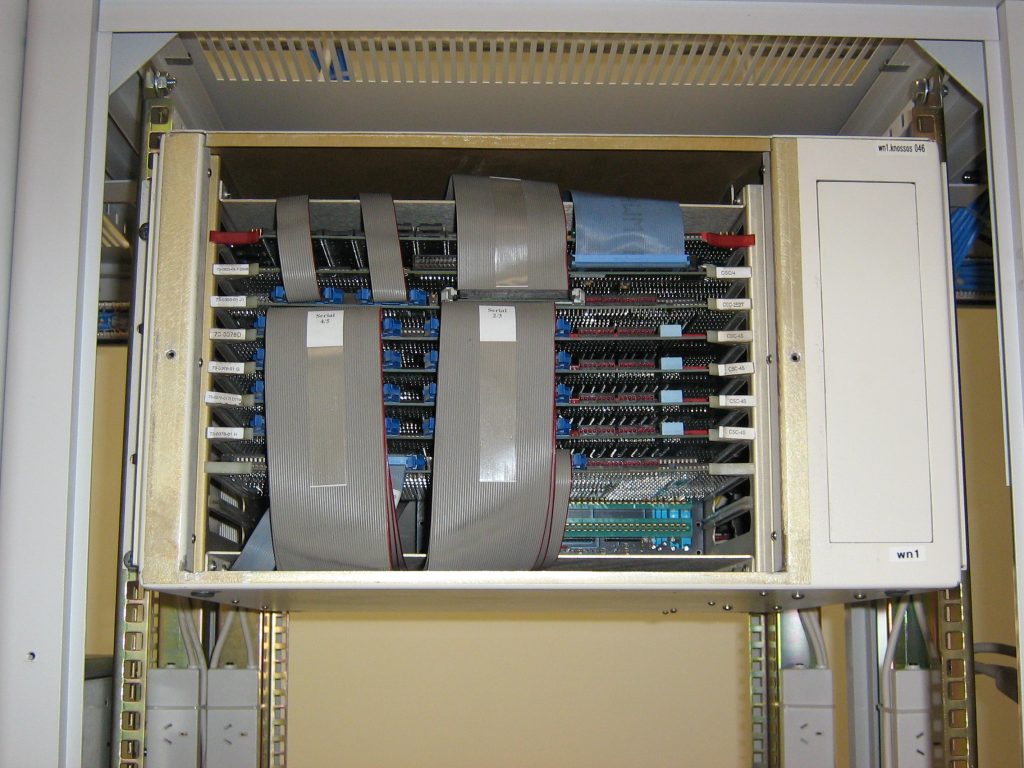
Front view with the cover off. The cards are:
- Non-volatile memory card (original).
- CSC/4 processor card (with console interfaces attached via the blue ribbon cable). You can also see the configuration register switches, partly hidden behind the wide grey ribbon cable. (Later routers put the configuration in non-volatile memory and use console commands to change it.)
- CSC-2E2T dual Ethernet, dual high-speed serial card. The narrow ribbons attach the AUI connectors, while the wide grey cables connect Serial0 and Serial1 on the two unlabelled V.35 connectors.
- CSC-4S four-port low-speed serial card, connecting four of the 16 DA-15 X.21 connectors.
- CSC-4S four-port low-speed serial card
- CSC-4S four-port low-speed serial card
- CSC-4S four-port low-speed serial card
- CSC-2E2S dual Ethernet, dual low-speed serial card, connecting two RS-449 connectors, plus two more Ethernet
- One empty slot
Note that the “S” cards were only rated for serial operation up to 64 kbps. However, the speed of a synchronous line is usually determined by a clock on the communications device (DCE), not set by the terminal equipment (DTE), as is the case for most asynchronous serial ports such as those found on a PC. You could have a Cisco operating as the “DCE” to another DTE and therefore operate as the clock source, and if you did that, it would indeed only allow you to set the speed up to 64k. In the normal DTE mode it just did what it was told, all the way up to 2M and possibly beyond.
Nevertheless, for commercial operations, it was considered good form to use the (rather more expensive) “T” cards for 2 Mbps operations. As the “T” cards were expensive, most >64k services were on other (non-Cisco) routers.
Both of the 2E2T card’s ports connected to 2M channels on a microwave link to the WCC, one to the WCC itself, and the other to a NetLink router located at the WCC to connect to CityLink.
Rear view
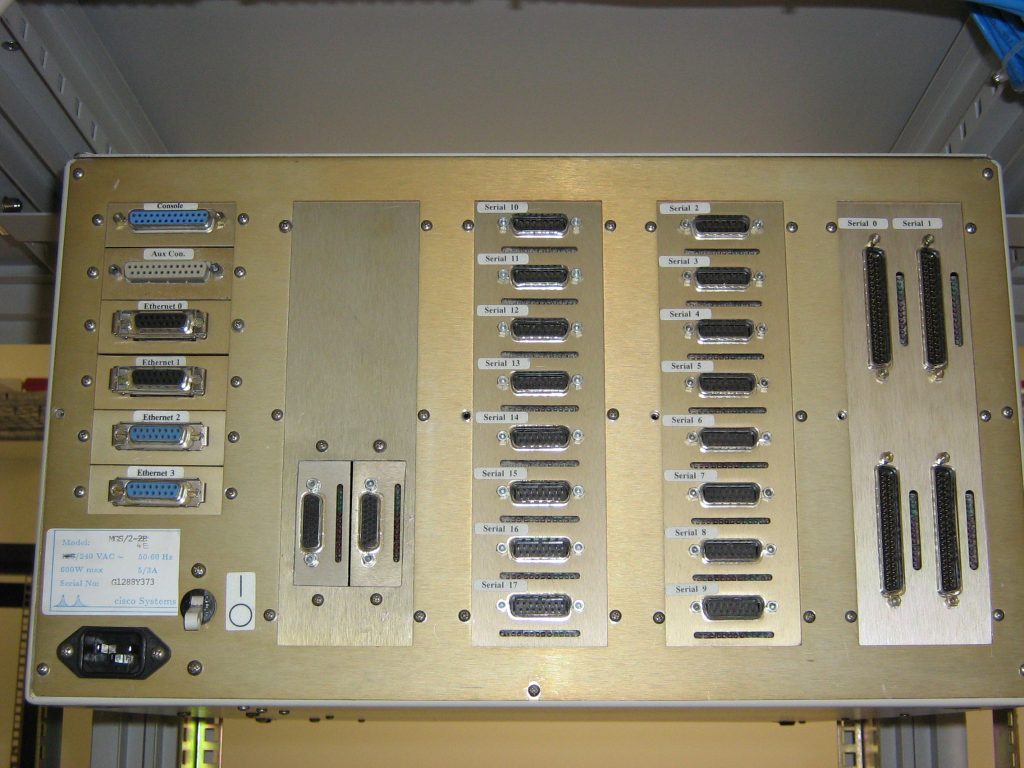
Rear view. From left to right, top to bottom, the data connections are:
- The two female DB-25s are the asynchronous console and auxiliary ports, connected to the CSC/4 CPU card.
- The four AUI ports (female DA-15s with slide-locks), labelled Ethernet0 through 3, connect to the CSC-2E2T card (Ethernet 0/1) and the CSC-2E2S card (Ethernet 2/3).
- the second panel has two V.35 connectors (female DA-26 sockets), connected as Serial 0/1 to the CSC-2E2T card. (This panel was modified from a blanking plate to carry the two connectors inserts.) These were the only V.35 interfaces used by NetLink, as they were the only options on the 2Mbps modems needed to connect the 2M microwave circuits to the WCC. (Later high-speed services used native PRI interfaces on different hardware.)
- The next two panels contain 16 X.21 connectors (male DA-15s), connected to the four CSC-4S cards.
- Finally the right-most panel contains four RS-449 connectors (male DC-37s). These were used with RS-449 to X.21 cables (We had a preference for X.21 on synchronous links.). The Serial 0/1 labels predate this configuration; they were actually Serial 18/19 (connected to the CSC-2E2S card). The bottom two sockets are not connected. Originally, this panel and cables connected the Kawaihiko links to Waikato, Massey and Canterbury Universities.
Manufacturer’s label
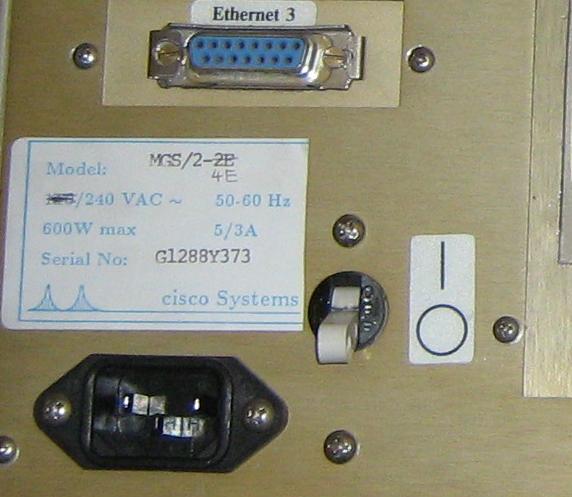
Close-up of the manufacturer’s sticker on the back, with the name “MGS/2-4E” betraying its origins.
Earl Baugh says:
Question:
1) Do you still have this item
2) Do you have pictures of the CPU board?
I’m doing some research on some early Cisco equipment (for restorations) and could greatly use some images of the CPU board (front and back).
If you are thinking of parting with any of this, please let me know.
July 16, 2014, 7:01 amCurtis Hill says:
I would really like to know if this is still in service. Even more would love to chat with CIO
July 27, 2017, 5:04 pmThanks
admin says:
I’ve replaced the pictures of this with some slightly newer ones. (For some reason the old pics didn’t survive the transfer to the new web host, even though the ones attached to posts did.) I’s also added some more technical detail.
February 24, 2026, 11:55 pm